

Foothills ADU Rules: A Guide for Placer County Homeowners
Accessory Dwelling Units, often called ADUs, guest houses, granny flats, in-law units, backyard cottages, or accessory homes, have become one of the most talked-about property improvements in California. Here in the Placer County foothills, they can be especially valuable because so many properties offer space, privacy, multigenerational living potential, and long-term flexibility.
Whether you are thinking about building a detached cottage for a parent, converting part of your home for an adult child, adding a rental unit, or buying a property with future ADU potential, the rules can feel confusing at first. The good news is that California and Placer County have made ADUs easier to explore, but every property still needs to be evaluated carefully.
What Is an ADU?
An ADU is a secondary housing unit located on the same property as a primary residence. It is smaller than the main home but is designed to function as its own livable space. A true ADU generally includes a sleeping area, bathroom, and kitchen or cooking area.
ADUs can be detached from the main home, attached to the home, built above a garage, created through a garage conversion, or carved out of existing interior space. Placer County often refers to these as “accessory homes,” which is a helpful way to think about them: they are secondary homes that add flexibility to a property.
A Junior ADU, often called a JADU, is different. A JADU is usually smaller and is created within an existing or proposed single-family residence. It can be a great option in certain situations, but it is not the same as a full detached guest house.
Why ADUs Make Sense in the Placer County Foothills
The foothills are uniquely suited for ADUs because many properties have larger lots, natural privacy, flexible layouts, and enough distance between neighbors to make a second living space feel comfortable. In areas like Auburn, Meadow Vista, Newcastle, Penryn, Loomis, Foresthill, Colfax, Applegate, and the surrounding unincorporated areas, an ADU can be both practical and valuable.
For some homeowners, the motivation is family. An ADU may allow an aging parent to live close by while still maintaining independence. It may give an adult child a place to live while saving for a home. It may also provide space for a caregiver, visiting family, or long-term guests.
For others, the motivation is financial. An ADU may provide rental income, help offset a mortgage, support retirement planning, or improve the overall usefulness of the property. In a market where housing is expensive and inventory is limited, a well-designed ADU can create options that many buyers value.
The best ADUs are not just about today’s need. They are about creating flexibility for the future.
Basic ADU Rules in Placer County
Placer County allows several types of accessory homes, including detached ADUs, attached ADUs, interior conversions, garage conversions, and units above garages. The county also provides guidance through its Accessory Homes and ADU 101 resources, which are excellent starting points for homeowners.
One of the most important things to understand is that state law has made ADUs easier to approve, but that does not mean every property automatically qualifies without site review. The land itself still matters. Septic capacity, sewer availability, water supply, setbacks, slope, access, easements, utilities, fire requirements, and drainage can all affect what is possible.
This is especially true in the foothills. A property may have several acres and still have limitations if the usable building area is small, the septic system cannot support another unit, the driveway is too steep, or fire access is challenging.
Sources & Helpful Links

Placer County Accessory Homes / ADU Resource Page
https://www.placer.ca.gov/accessoryhomes
Placer County ADU 101 Guide
https://www.placer.ca.gov/6651/Accessory-Dwelling-Unit-101
Placer County Pre-Approved ADU Plans
https://www.placer.ca.gov/6650/Pre-Approved-Accessory-Dwelling-Unit-Pla
California HCD ADU Information
https://www.hcd.ca.gov/building-standards/adu
California HCD ADU Handbook
https://www.hcd.ca.gov/building-standards/adu/handbook
California HCD Funding for ADUs
https://www.hcd.ca.gov/building-standards/adu/funding
Placer County Eastern Placer Launchpad Program
https://www.placer.ca.gov/Launchpad
City of Auburn Municipal Code ADU Section
https://auburn.municipal.codes/ACC/18.31.120
2026 ADU Rule Updates
California ADU law has changed several times in recent years, and Placer County has noted that state ADU codes were updated as of January 1, 2026. The county is working to reflect those changes locally and advises property owners to refer to California state code for ADU development standards while local updates are being completed.
Placer County’s ADU regulation update page notes several major local ordinance updates, including increases to the number of ADUs allowed on certain single-family and multifamily parcels. This is an important reminder that ADU rules are evolving, and homeowners should always verify the current standards before investing in plans, engineering, or construction.
In simple terms, ADUs are being encouraged, but the details still matter. The safest approach is to check both California HCD guidance and the local jurisdiction that governs the specific property.
City or County: Why Location Matters
One of the first questions to ask is whether the property is located in unincorporated Placer County or inside a city limit, such as Auburn, Loomis, Rocklin, Roseville, Lincoln, or Colfax. This matters because the permitting authority, local code, utility requirements, and review process may differ.
For example, a property with an Auburn mailing address is not always inside the City of Auburn. Some Auburn-addressed properties are in unincorporated Placer County. Before relying on any rule, homeowners should confirm which jurisdiction controls the parcel.
This is one of the most common areas where property owners get confused. The address may say Auburn, but the rules may come from Placer County, the City of Auburn, or another local agency depending on the parcel location.
Septic, Sewer, and Water Are a Big Deal
In the foothills, septic and water are often the make-or-break issues for ADU feasibility. A property may have the zoning and space for an ADU, but if the septic system cannot support the additional bedroom count or occupancy, the project may require upgrades or may not be practical.
Homes connected to public sewer may have a different path than homes on septic. Properties with wells may need to consider water production, water quality, storage, and long-term reliability. These issues should be evaluated early, before a homeowner spends money on design work.
For buyers, this is especially important. If ADU potential is part of the reason you are buying a foothill property, do not rely only on lot size. Review septic records, well information, building envelopes, easements, slope, and access before assuming an ADU will be possible.
Parking and Access
California ADU law has reduced many parking barriers, and Placer County’s ADU resources discuss parking as part of the overall development review. However, even when parking is not the legal obstacle, it can still be a practical issue.
In the foothills, driveways can be steep, roads can be narrow, and usable flat space may be limited. Homeowners should think through where residents, guests, contractors, delivery vehicles, and emergency vehicles will actually park and turn around.
Good ADU planning is not just about meeting the minimum rule. It is about making sure the property will function well after the ADU is built.
Fees, Costs, and Pre-Approved Plans
One of the biggest incentives for ADUs is that some fees may be reduced or eliminated depending on the size and type of unit. Placer County also offers pre-approved ADU plans, which can help homeowners save time and money during the design and review process.
Placer County states that using its pre-approved plans may save an estimated $6,000 to $10,000 in design fees, and the county’s pre-approved plan program allows homeowners to review plan options that have already been evaluated for current building code conformance.
However, a pre-approved plan does not mean the ADU is automatically approved for every lot. The building design may be pre-reviewed, but the property itself still needs site-specific review. Setbacks, septic, water, utilities, grading, fire access, drainage, and easements still matter.
For many foothill homeowners, a smaller and efficient ADU may be more realistic than a large custom structure. Bigger is not always better. A well-placed, well-designed ADU that fits the land can be more valuable than an oversized unit that creates privacy, access, or cost problems.
Funding Options
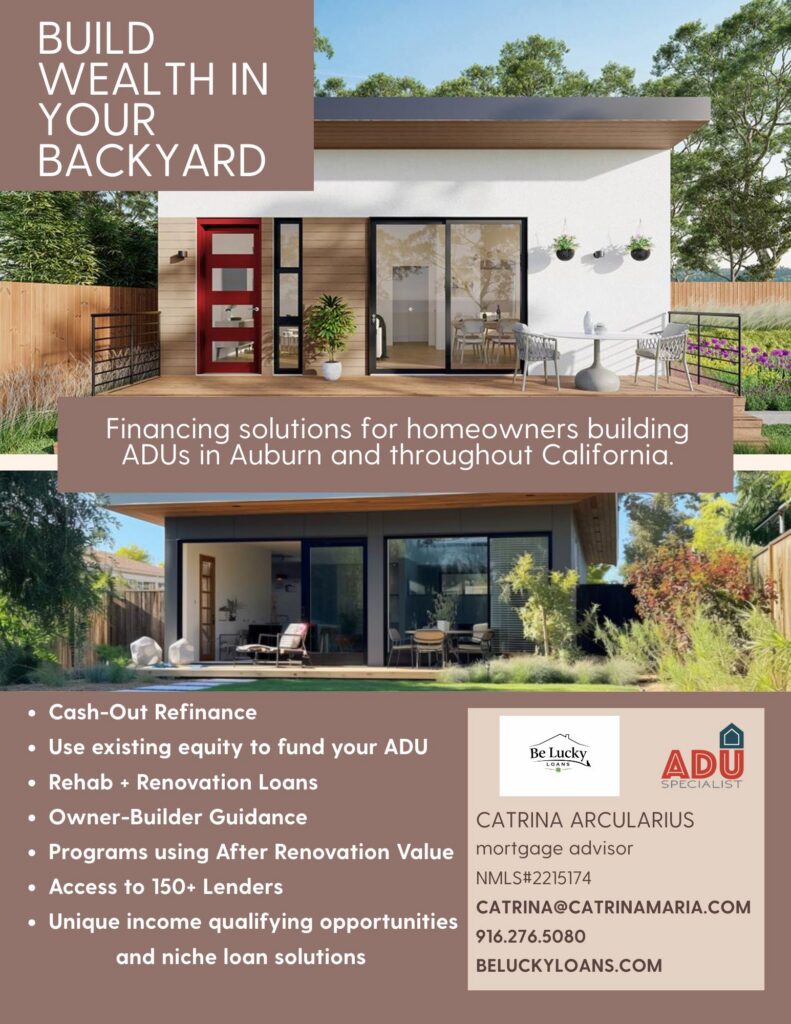
Working with a local knowledgeable ADU finance specialist allows me to provide a trusted source if additional funding is needed.
Financing an ADU does not always have to come from cash savings alone. Homeowners may be able to explore options such as a cash-out refinance, rehab or renovation loans, owner-builder guidance, loan programs that consider after-renovation value, and niche loan solutions that may help with unique income-qualifying situations.
Who Is a Good Candidate for an ADU?
A good ADU candidate is not just someone with extra land. The best candidates usually have a combination of usable property, realistic expectations, a clear purpose, and the financial ability to complete the project properly.
A property may be a strong ADU candidate if it has usable land, reasonable access, adequate septic or sewer capacity, reliable water, workable setbacks, practical parking, and a layout that allows privacy between the main home and the ADU.
A homeowner may be a strong candidate if they are planning for multigenerational living, rental income, long-term flexibility, retirement, caregiver support, or future resale value. The clearer the goal, the better the design decisions will be.
Who May Not Be a Good Candidate?
Not every property is ideal for an ADU. A site may be challenging if it has steep slopes, limited access, poor drainage, septic limitations, weak well production, fire access issues, complex easements, or limited usable land.
A homeowner may also want to pause if the budget is too tight. ADUs can be a smart investment, but they are still construction projects. Site work, utility upgrades, septic improvements, engineering, permitting, and construction costs can add up quickly.
The better question is not simply, “Can I build an ADU?” The better question is, “Does an ADU make sense on this specific property, for this specific purpose, at this specific cost?”
ADUs and Property Value
A permitted ADU can add meaningful value because it adds flexibility. Buyers often appreciate properties that can support family, guests, rental income, caregivers, or remote work. In the foothills, where many buyers are looking for lifestyle and long-term usability, an ADU can be a strong selling feature.
That said, not every ADU adds value equally. A properly permitted, thoughtfully placed ADU with good design and documentation is very different from an awkward or unpermitted conversion.
From a real estate perspective, documentation matters. Permits, final inspections, septic records, utility information, rental history, and square footage details can all affect how confidently buyers, lenders, appraisers, and insurance companies view the unit.
Buying a Property with ADU Potential
If you are buying in the Placer County foothills and want ADU potential, do not rely on acreage alone. A property may look ideal online but still have septic, slope, access, well, easement, or utility complications.
The best approach is to evaluate the property carefully during the investigation period. Review jurisdiction, zoning, septic records, well information, parcel maps, easements, utility locations, driveway access, fire access, and usable land.
ADU potential can be a wonderful bonus, but it should be verified before you make major decisions based on it.
Selling a Home with an ADU or ADU Potential
If you are selling a home with a permitted ADU, the ADU should be marketed clearly and responsibly. Buyers will want to know whether it is permitted, how it is heated and cooled, whether it has separate utilities, how it connects to septic or sewer, and whether it has rental history.
If the property does not have an ADU but appears to have strong ADU potential, that can also be part of the marketing story. However, “potential” should never be overstated. The best approach is to point buyers toward the correct county, city, planning, building, septic, and utility resources so they can verify what is possible.
Biggest Mistakes Homeowners Make
The biggest mistake is assuming that because California encourages ADUs, every property can easily have one. State law may support ADU development, but local property conditions still matter.
Other common mistakes include designing before checking septic capacity, underestimating utility costs, ignoring fire access, assuming a pre-approved plan automatically works on every lot, building without permits, failing to review easements, and assuming rental income without understanding local demand and expenses.
A successful ADU project starts with research, not assumptions.
Questions to Ask Before You Start
Before moving forward, homeowners should ask:
- What is the main purpose of the ADU?
- Is the property in unincorporated Placer County or inside a city limit?
- Does the property use septic or sewer?
- Is there enough water capacity?
- Are there easements, setbacks, slope, drainage, tree, utility, or fire access issues?
- Where will people park?
- Will the ADU create privacy concerns?
- What is the realistic budget?
- Would a detached unit, attached unit, garage conversion, or interior conversion make the most sense?
These questions may not be as exciting as choosing finishes or looking at floor plans, but they are the questions that can save time, money, and frustration.
Final Thoughts
ADUs are one of the most practical housing solutions for the Placer County foothills because they meet real-life needs. They can help families stay close, create rental income, support aging parents, add flexibility, and make better use of existing residential land.
But the most successful ADU projects start with the right research. Before you build, check the rules. Before you buy, verify the property. Before you sell, understand how an ADU or ADU potential should be positioned.
In the foothills, an ADU is not just an extra structure. Done well, it can become one of the most useful and valuable parts of a property.