
Looking at acreage or a foothill home and wondering whether irrigation water in Placer County really matters? Drive the back roads around Auburn, Newcastle, Penryn or Loomis in July and you can usually tell which parcels have it. They are the ones with green pasture, full orchards and gardens that look happy instead of crispy.
In the Placer County foothills, irrigation water is one of the most valuable features a property can have, and one of the most overlooked. Listings mention square footage and views first. But for anyone who wants animals, trees, a serious garden or simply a defensible green buffer in fire season, a canal connection can matter more than an extra bedroom.
This guide covers what irrigation water means in Placer County, what it costs compared to treated water, what it makes possible on your land, how it affects property value, and what to check before you buy or sell a property that has it.
What Is Irrigation Water in Placer County?
Irrigation water here is untreated (raw) water delivered by canal or pipe from Sierra rivers and reservoirs. It is not drinking water. It is meant for pasture, livestock, orchards, gardens and landscaping.
Much of the foothill canal network traces back to Gold Rush-era mining ditches that were later turned to farming. Today two public agencies deliver most of it in the county:
- Placer County Water Agency (PCWA) owns and maintains about 170 miles of its own canals and also receives water through PG&E canals. It serves raw water customers from Alta down through Auburn, Newcastle, Penryn, Loomis and Rocklin.
- Nevada Irrigation District (NID) serves farms, fields and homes across Nevada, Placer and Yuba counties, including parts of north Auburn and the Lincoln area.
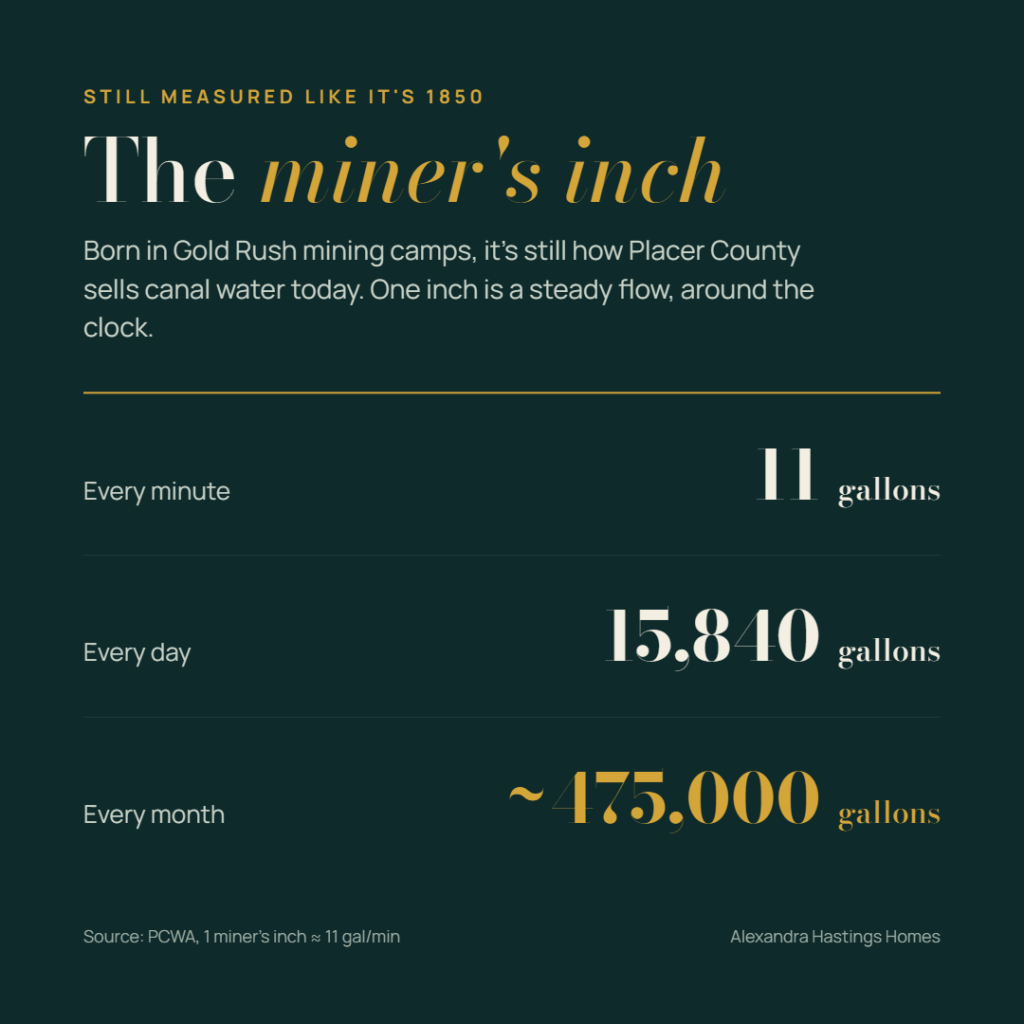
Water is sold by the miner’s inch, a continuous flow. PCWA puts one miner’s inch at about 11 gallons per minute. Run around the clock, that is roughly 15,800 gallons a day.
PCWA’s summer season runs April 15 to October 15, with winter service the rest of the year. NID’s winter water runs roughly October 15 through April 14 and is secondary to summer deliveries.
How Much Does Irrigation Water Cost Compared to Treated Water?
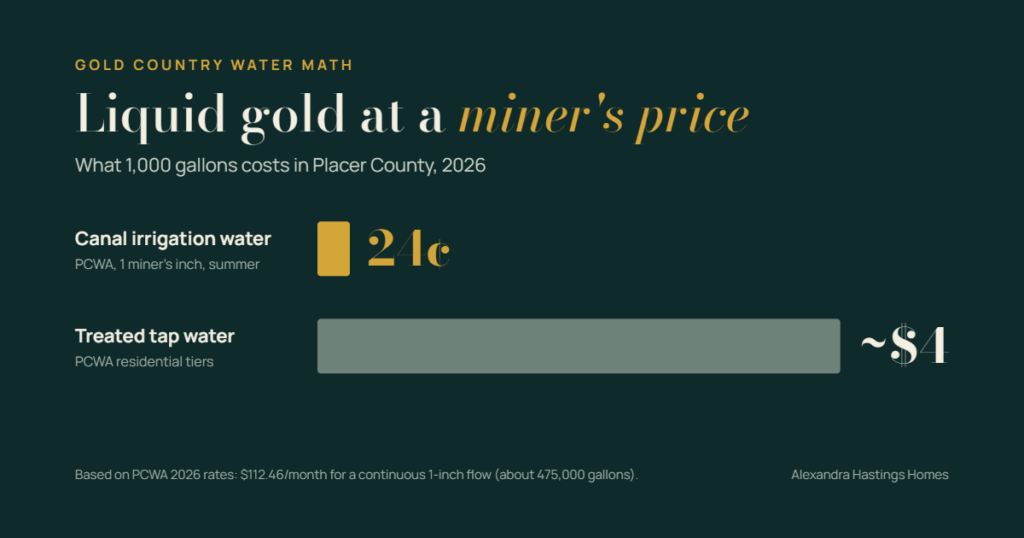
Canal water costs a fraction of what treated tap water does. In 2026, PCWA’s sample bill for one miner’s inch of summer irrigation water is $112.46 a month.
That inch runs continuously, so it can deliver about 475,000 gallons in a 30-day month. Buying the same volume as treated residential water at PCWA’s 2026 tiered rates would cost roughly $1,900. That works out to about 24 cents per 1,000 gallons for canal water versus about $4 for treated water.
Few owners use every drop of their flow, but the point stands. Keeping an acre of pasture or a small orchard alive on drinking water is expensive. On canal water, it is a routine monthly bill.
NID customers see similar economics, though rates are rising. NID’s board approved a 9 percent increase in irrigation rates for 2027, about $13.61 more per month for a one-inch summer customer.
What the heck is a Miner's inch?
It’s a Gold Rush original. Miners in the 1850s needed a way to measure the water they bought from ditch companies, so they measured flow through a small opening in a board. The name stuck, and Placer County canal water is still sold by the miner’s inch today. PCWA puts one miner’s inch at about 11 gallons per minute. That steady flow adds up to roughly 15,800 gallons a day, or about 475,000 gallons in a month.
What Can You Do With Irrigation Water on Placer County Property?
Irrigation water turns a foothill lot from “house with dry grass” into usable land. Common uses include:
- Irrigated pasture for horses, cattle, sheep or goats, which can cut hay bills sharply through the summer.
- Orchards and vineyards. Placer’s foothills have a long fruit-growing history, from Newcastle and Penryn mandarins to stone fruit, olives and wine grapes.
- Large vegetable gardens and small farm operations selling at local markets.
- Ponds that hold water for stock, wildlife, scenery and backup storage. PCWA itself recommends a pond or tank to ride out outages.
- Green, fire-wise landscaping. Irrigated lawn, pasture and orchard around a home stay green longer into fire season than dry grass and brush.
Few owners use every drop of their flow, but the point stands. Keeping an acre of pasture or a small orchard alive on drinking water is expensive. On canal water, it is a routine monthly bill.
Does Irrigation Water Add Value to a Placer County Property?
For the right buyer, an active irrigation connection is a feature they will pay for and a missing one can be a dealbreaker. Buyers shopping for acreage with horses, a hobby farm or an orchard in mind often filter for canal water first.

Part of the value is scarcity. New raw water service is not guaranteed. PCWA ranks new untreated deliveries by use: commercial agriculture or livestock next to a canal comes first, and general landscaping comes last. New party lines and lot splits are limited to one canal turnout and one account. A parcel that already has service in place skips that uncertainty.
Irrigation water also protects the domestic well. Many foothill homes rely on wells drilled into hard rock that produce modest flows. Running pasture or orchard irrigation off the well can strain it. Canal water carries the outdoor load and saves the well for the house.
It is not drought-proof. In 2024, damage at a PG&E facility led PCWA to ask raw water customers to voluntarily cut back or suspend summer deliveries. Storage, such as a pond or tank, is what turns a good water source into a reliable one.
What Should You Check Before Buying a Property With Irrigation Water?
“Has irrigation water” can mean many things. Before you count on it, confirm the details:
- Is service active? Ask the seller for recent PCWA or NID bills and the account number. Call the agency to confirm the account and its status.
- How much water? Find out how many miner’s inches are ordered for summer and winter, and whether that suits your plans. A half inch waters a garden; pasture needs more.
- Which district, and inside or outside it? With NID, rates differ for out-of-district customers. At a July 2026 workshop, an out-of-district customer cited a 217 percent first-year increase in their rates.
- Private or shared line? On a party line, learn how many neighbors share it, how water is split and who maintains it. PCWA lets existing party lines form an association with one consolidated account.
- What is on the property? Look at the turnout, delivery box, pipes, pump (ideally with a low-water cutoff), pond or tank and the irrigation system itself.
- Easements and access. Confirm recorded easements for the ditch or pipeline. Owners must also give PCWA safe access to its facilities.
- Who fixes what? The owner is responsible for leaks on the private side of the turnout.
Your agent and title company can help with records, but the water agency is the final word on what service a parcel has.
Make Foothill Living Work for You With Irrigation Water
In the Placer County foothills, irrigation water is often the difference between owning acreage and using it. It costs a fraction of treated water, supports animals, trees and gardens, eases the load on your well and helps keep your surroundings green in fire season.
If you are buying, treat water service as seriously as the roof or the septic. If you are selling, make sure buyers know exactly what you have: the district, the inches, the infrastructure and the history.
Thinking about buying or selling a property with irrigation water in Placer County? I would be happy to help you find land with the water you need, or show buyers exactly what your water service is worth. Explore homes and acreage in Auburn, Newcastle, Loomis and the surrounding foothills, and reach out anytime with questions.
Water rates, seasons and service rules change from year to year. Please confirm current details with PCWA or NID before making decisions about a property.